Selecting the right continuous level transmitter for a liquid storage tank directly affects measurement accuracy, process safety, and long-term maintenance costs. Two technologies dominate the conversation: magnetostrictive and ultrasonic. Each performs differently when confronted with foam, turbulence, vapor, and shifting fluid properties, and those differences matter most in demanding service, such as the wastewater level measurement challenges facilities face every day. This guide compares both technologies, explains where each succeeds and struggles, and shows how Jogler’s MGT-6000 and ILT-6000 magnetostrictive transmitters deliver reliable, high-accuracy results across a broad range of storage tank applications.
Jump To:
How Each Technology Works
Before comparing performance, it helps to understand the operating principle behind each of these industrial-level transmitter types.
Magnetostrictive technology uses time-of-flight measurement along a waveguide. A magnetic float rides the liquid surface, and the transmitter sends a current pulse down the waveguide. The interaction between the pulse and the float’s magnetic field generates a return signal, and the transmitter calculates level from the elapsed time. Because measurement depends on the float’s physical position rather than a reflected signal, the reading stays stable regardless of vapor space conditions.
Ultrasonic technology transmits sound pulses from a sensor mounted above the liquid. The pulse travels through the vapor space, reflects off the liquid surface, and returns to the sensor. Level is derived from the time of flight. Because the measurement travels through the air or vapor above the liquid, anything that disturbs that path affects accuracy.
That distinction is the root of most performance differences between the two technologies.
Ultrasonic Level Transmitter Limitations
Ultrasonic devices are non-contact and straightforward to install, but their reliance on a clean sound path introduces several ultrasonic level transmitter limitations in real-world storage tank service:
- Foam: Surface foam absorbs and scatters sound energy, producing readings that drift high or drop out entirely.
- Turbulence: Agitators, incoming flow, and pump activity break the surface into a moving target that scatters the return signal.
- Vapor and temperature gradients: Heavy vapor, condensation, and changing air density alter the speed of sound, skewing the calculated distance.
- Dead zones: A blanking distance near the sensor face limits measurement at high fill levels.
These conditions appear constantly in aeration basins, sludge tanks, and lift stations, which is why ultrasonic devices frequently underperform in the wastewater level measurement challenges that operators must solve.
Magnetostrictive Advantages for Storage Tanks
Magnetostrictive transmitters sidestep the vapor-path problems that limit ultrasonic devices because measurement is tied to a physical float. This design supports several advantages that make magnetostrictive units a strong choice among continuous level measurement technologies.
High Accuracy and Repeatability
Jogler’s MGT-6000 and ILT-6000 deliver 0.01% full-scale accuracy, placing them firmly among high-accuracy level measurement sensors. The magnetostrictive level sensor accuracy remains consistent whether the surface is calm or disturbed, because the float tracks the true liquid level rather than a reflected signal.
Dielectric Independence
Unlike guided wave radar and signal-based devices, magnetostrictive technology does not require consideration of the medium’s dielectric constant. This dielectric independence allows the ILT-6000 to measure varying and dirty liquids without recalibration, a meaningful benefit where fluid composition shifts throughout the day.
Isolation and Serviceability
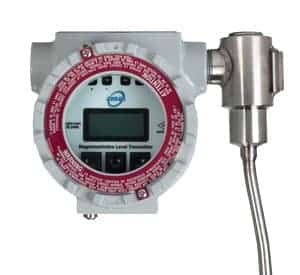
The ILT-6000 uses a low-profile waveguide inserted into a sensor well and float assembly. The well isolates the waveguide from the process environment and provides an additional safety barrier, and the transmitter can be removed for field checking or calibration without shutting down the process. The MGT-6000 mounts externally to a magnetic level gauge and includes vibration-isolating elastomeric bushings that ensure continuous operation in high-vibration service.
Integration and Outputs
Both transmitters are loop-powered, 2-wire devices with 4-20 mA output and HART communication, plus an LCD display for configuration and diagnostics. Each provides dual level outputs for total level and interface measurement. The MGT-6000 retrofits to most magnetic level gauges with no process interruption, making it a practical upgrade for existing installations.
Hazardous Area Suitability
Both units feature epoxy-coated aluminum enclosures rated NEMA 4X and carry hazardous area certifications, including Class I, Division 1, Groups A, B, C, D; Class II and Class III, Groups E, F, G; and intrinsically safe ratings. These approvals make them well suited to refineries, chemical plants, and wastewater facilities alike.
Which Level Transmitter Is More Accurate: Magnetostrictive or Ultrasonic?
When operators ask which level transmitter is more accurate: magnetostrictive or ultrasonic, the answer favors magnetostrictive technology in nearly all demanding conditions. Ultrasonic accuracy degrades with foam, turbulence, and vapor, while magnetostrictive accuracy holds at 0.01% of full scale because it measures a physical float position rather than an environmental signal path.
The practical takeaway:
- Choose ultrasonic for clean, calm liquids in vented tanks where non-contact simplicity is the priority.
- Choose magnetostrictive where accuracy, interface measurement, dielectric independence, or hazardous ratings are required.
Common Mistakes to Avoid
Even the right technology can underperform when specified poorly. Watch for these pitfalls:
- Ignoring vapor space conditions: Selecting ultrasonic for a foaming or high-vapor tank invites drift and dropouts.
- Overlooking interface needs: If you must track an oil-water interface, choose a transmitter with dual level outputs.
- Skipping serviceability planning: Favor designs like the ILT-6000 isolation well that allow removal without a process shutdown.
- Underrating the environment: Confirm NEMA and hazardous area ratings match the installation zone before ordering.
Quick Comparison Summary
| Factor | Ultrasonic | Magnetostrictive (MGT-6000 & ILT-6000) |
| Accuracy | Degrades with foam/vapor | 0.01% full scale |
| Foam/turbulence tolerance | Low | High |
| Dielectric sensitivity | Not applicable, but signal-path dependent | Independent |
| Interface measurement | Limited | Dual-level outputs |
| Serviceability | Sensor access | Removable without shutdown |
| Hazardous ratings | Varies | Class I/II/III certified, NEMA 4X |
For most storage and process vessels, this comparison points to magnetostrictive units as the best level transmitter for storage tanks that face variable or difficult conditions.
Which Choice Is Right for You?
Both technologies have a place, but they solve the measurement problem differently. Ultrasonic transmitters offer simple, non-contact installation for clean, stable liquids, while their reliance on a clear vapor path limits performance where foam, turbulence, and vapor are present. Magnetostrictive transmitters deliver dependable 0.01% full-scale accuracy, dielectric independence, dual level outputs, and hazardous area certification, making them the better fit for demanding service and the best liquid level transmitter for industrial tanks in most process environments.
If you’re specifying instruments for a new tank or upgrading an existing installation, Jogler’s engineering team will help you match the MGT-6000 or ILT-6000 to your process conditions. Contact Jogler to discuss your application or request detailed data sheets.
Toll-Free: 1-800-223-8469
Email: inquiries@jogler.com
Website: www.jogler.com